‘Siegfried’ from the Royal Opera House
Cameo, Edinburgh, 6/4/2026
‘Siegfried’ from the Royal Opera House
The Royal Opera House’s ‘Siegfried’, seen at the Cameo encore screening on Monday, has (finally) got Barrie Kosky’s Ring Cycle on track. Andreas Schager turns in a superb performance in the title role, and Kosky’s clear direction with its eccentric and anarchic moments brings many episodes of sheer enjoyment.
There’s always a paradox in the casting of the Ring – Siegfried is a fiendishly difficult role to sing, requiring high notes and stamina, but the singer should also be a convincing teenage boy. New Zealander, Simon O’Neill had the Heldentenor voice in the last Ring Cycle seen in Edinburgh, the EIF semi-staged version from 2016 to 2019, mainly conducted by Andrew Davis, but he was too ponderous to be a convincing youth. Austrian Andreas Schager, in his ROH debut, is little-known in the UK, but has been singing the big Wagnerian roles in Germany since 2009 and was Siegfried at the Met in 2019. His exuberance and boyish optimism are the hallmarks of his acting, his singing is flawless - vigorous, lyrical and tender - and his onstage charisma clearly wowed the opera house.
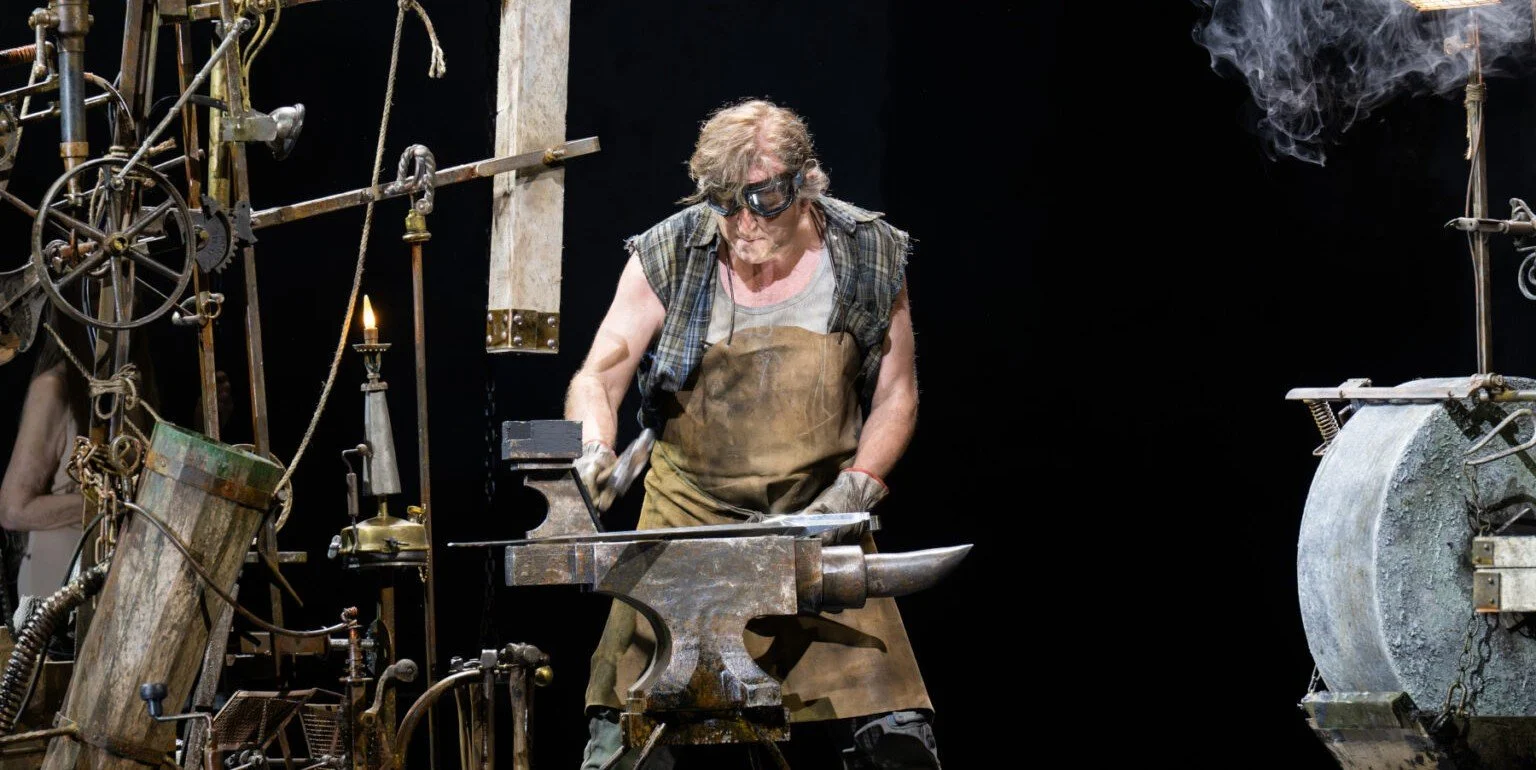
With a small number of characters, everyone’s performance matters, as the opera works largely through dialogues/conflicts between pairs of characters. In Act I Schager, with his enthusiasms and childish revulsion, provides the perfect foil for Peter Hoare’s chaotic Mime. Dressed in cast-offs – a waistcoat made of crochet squares in Act I - he fails to make any headway with the sword-forging in his tree-house workshop – in frustration he beats the anvil rat-a-tats on his metal helmet – until Siegfried takes on the task himself using two Heath Robinson forges (the product of the ROH armoury department). Christopher Maltman, not always convincing as Wotan in the earlier operas, here, with battered face and ragged clothes, is more relaxed in his Wanderer alter-ego. The riddle session with Peter Hoare shows a mind desperately hard at work, in a scene visually reminiscent of ‘Waiting for Godot’. Meanwhile the actor, Illona Braithwaite, naked throughout as Erda, is a constant benign, although often puzzled, presence.
The snowy landscape with lamp-post in Act II is Narnia just behind the Wardrobe. Erda, normally invisible, here forms a bond with Siegfried whose monologues about his origins are communicated to her on a handy park bench. Soon, with bird feathers attached, she becomes the Woodbird, (sung off-stage by Sarah Dufresne), a gently comic scene which both carry off well. Siegfried kills Fafner (in spiky gold suit), and Mime, without a qualm, yet the Act’s end which sees him and the Woodbird walk off hand-in-hand, like an illustration of Lucy and Mr Tumnus, seems touchingly innocent.
The Wanderer’s downfall is movingly enacted by Maltman. Three encounters, with Alberich (a convincing performance by Christopher Purves), with Erda (Wiebke Lemnkuhl, appearing from the voluminous skirt of the actor Erda) and finally with his grandson, Siegfried, who breaks his staff, make Wotan accept that the gods’ rule is coming to an end.
The two Erdas’ floral gowns are well over the top, and so is the meadow set for the rest of Act 3, with hyper-realistic flowers, under which Siegfried finds Brünnhilde - no armour, or fire in sight - as she emerges from the grass in a simple embroidered dress. Once he realises that she’s not his mum, Siegfried and his auntie get on fine! The opera ends with some terrific singing and beautifully acted interplay between the two, who have difficulty stopping smiling at their good fortune.
The programme speaks of ‘Siegfried’ as the ‘Scherzo’ of the Ring Cycle, a label suggesting jokes and off-beat rhythms, which certainly fits Barrie Kosky’s direction, as well as some of the music in the earlier Acts of the opera. Antonio Pappano, an excellent Wagner conductor (I heard him twice conducting Keith Warner’s Ring) comments on the change in the musical style as we go into the last Act. This is where Wagner picked up the work again in 1869 after leaving it unfinished for 12 years. Certainly his complex music for one farewell and two new beginnings is what underpins this wonderful finale.
It appears that the full cycles of this Ring will be in in September 2027, though it’s unclear if, before that, there will be single performances of ‘Götterdämmerung’ in the 26-27 season (which would be unusual).
Photo credits: © 2026 The Royal Opera, Monika Rittershaus