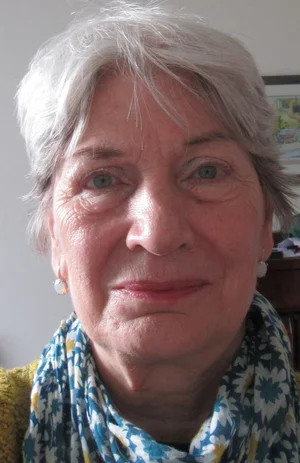
Angus Calder 1942-2008 Reviews 1985
Hugh and I
August 23 1985
“This Bolshevik bog! Suits me doon to the grun’!” The weather was perfect for the unveiling of Jake Harvey’s fine sculpture commemorating Hugh MacDiarmid on a hillside above his native Langholm. As rain fell in an apocalyptic downpour, scores of laughing admirers tottered about in the mud rejoicing that God’s quarrel with the Promethean poet weren’t over. On the coach which brought some of us back to Edinburgh, just as the Festival was beginning, a critic’s test was beginning to form in my mind: of what, in all this greatest show on earth, might MacDiarmid have approved? Not that I’d always agree with him (who could?); but usually.
Well, Timothy Neat who organised the unveiling, has made a very moving documentary film about Sorley Maclean, the great modern Gaelic poet. ‘Hallaig’ has been showing at the College of Art (Fringe) and MacDiarmid would have applauded that. And how could he not have welcomed Eric Bentley? The friend and translator of Brecht is giving a daily Fringe cabaret. Nearly 70, he admits to having little voice, but he interprets his own translations of Brecht and Prévert with such authority and charm that audiences must feel privileged to meet him.
This year, the ‘Auld Alliance’ between Scotland and France provides a theme for concerts, plays and exhibitions in the ‘Official’ programme. French Connections, an exhibition at the Royal Scottish Museum, displays, among numerous luxury knickknacks, acquired by wealthy Scots, respectful letters to David Hume from Montesquieu, Diderot, Buffon and other luminaries of the Enlightenment. MacDiarmid, apostle of high intellectualism (as well as Communism and Nationalism) would have relished these trophies from a period when Scottish minds reordered European thought.
But I don’t think he’d have thought much of the first operatic attraction, Chabrier’s ‘L’Étoile’ (Official). This zany farce set in never-never Africa was performed with utter charm by Opéra de Lyon under the baton of John Eliot Gardiner, in the newly redecorated King’s Theatre. People enjoyed it so uninhibitedly you’d have thought you were in Glasgow. I loved it too but couldn’t see that it had the edge over, say a topnotch production of ‘The Gondoliers’.
‘Official’ drama this year includes no fewer than four Scottish plays. Local people have responded by packing the theatres. Lyndsey’s ‘The Thrie Estaites’ was back at the Assembly Hall – the same production as last year but now, I think, better spoken. The spectacle appeals to foreigners and locals alike and it would make sense to repeat it every year.
‘A Wee Touch of Class’ is adapted by Denise Coffey from ‘Le Bourgeois Gentilhomme’. It is hardly Molière’s most profound play and the new version in Scots is unashamedly a vehicle for Rikki Fulton’s supreme skills as a pantomime comic. It’s been on at the Church Hill Theatre in Morningside, that legendary suburb of Edinburgh where ‘sex’ is what the coalman brings his wares in. For some reason the Edinburgh bourgeousie loves to hear actors use the vernacular which it itself eschews in everyday life, so long as nothing too serious is said. But there is no real vice in this amiable romp. I fear the same cannot be said about ‘When I was a Girl I used to Scream and Shout’. This flimsy concoction has filled the Lyceum, but in contrast with the committed feminist assault of Liz Lochhead, Sharman Macdonald’s treatment of adolescent sex provokes cheerful sniggers. I left at the interval lest my ever-more audible groans might spoil others’ fun.
Why the Official Festival bought it, I can’t imagine. I’m told the Traverse had the sense to turn it down. Despite that theatre’s unnerving propensity to change performance times without visible notice, I am very impressed by the rich programme on offer there, including one truly outstanding play by an Edinburgh-based writer, John Clifford. ‘Losing Venice’ begins in a stylised ‘Spain’ at some indeterminate time between the Reconquest and the age of Goya. The poet Quevedo goes thence with his patron, a Duke, on a mission to save Venice from the Turks. Adventures include a hilarious fight with pirates at sea. Jenny Killick’s production zestfully matches the writer’s fecund imagination and the young cast is uniformly splendid. I was particularly taken by Simon Donald, whose physically and vocally nimble -performance as a Scots-speaking servant shows up by its freshness the routine caricature of the Lower Order types in ‘A Wee Touch of Class’. Clifford echoes Renaissance romance, Cervantes, Voltaire, but wears his learning as if it were gossamer. Fun turns to thoughtfulness as the horrors of war are denounced and the Duke is exposed as a sterile addict of power and violence. With its combination of comic exuberance, erudition and anti-authoritarianism humanism this play reminds me strongly of Alasdair Gray’s fiction.
Best till last. MacDiarmid wished Scottish culture to live in a modern and international ambience. One afternoon at the Queen’s Hall, Yehudi Menuhin met the Whistlebinkies, a folk band, and six fiddlers expert in different styles. ‘Mr Menuhin’s Delight’ (Official) triumphed because it was so nearly a cockup. Audience and performers were united by a common fear of disaster. The Beeb, recording the event, had failed to provide technology to ensure that Menuhin’s conversations about technique with other artists could be heard in all sections. Some of the fiddlers seemed frightened by the occasion. But they played gloriously. Ron Gonnella’s suavely beautiful tone contrasted with Bob Hopkirk’s bagpipe-influenced style and the great Aly Bain’s fierce Norse-Shetland virtuosity. The occasion became historic when Edna Arthur played with supreme skill and intensity a magnificent pibroch dating back to 1526 transcribed for fiddle in the late 18th century. Whistlebinkies’ flautist, Eddie McGuire, is also Scotland’s leading avant-garde composer (and left-wing with it). The final item was a new slow air and reel written by him for Sir Yehudi. All the performers assembled to participate. The great man, due to lead off, stepped nervously up to the rostrum, fluffed on the first note, said sorry, and plunged on at once like a small child performing in its first school concert. The piece was fine, the applause tumultuous; Menuhin played much better in the encore. I felt I was hearing the feudal past being ferried across to the socialist future. Elated, I went out into another torrential downpour. God doesn’t like to see Scotland getting too big for its boots – or rather, growing into bigger ones.
Jazzed Up
30 August 1985
Hailing a cab in mid-Festival I found myself in Bob’s Fringe Taxi. Bob wears a Glengarry, has bedecked his cab with tartans and plays you Jimmy Shand on cassette. A ride with him must constitute the smallest and shortest Festival event.
But not the cheapest, of course. Elsewhere you could go round all day, spend not a penny and have a very good time. Street theatre flourishes at the bottom of the Mound, where I’ve watched a man putting pythons’ heads into his mouth, and free art exhibitions abound. Komar and Melamid at the Fruitmarket Gallery are Soviet exiles who offer, downstairs, big clever parodies of Socialist Realism, upstairs, more private jokes, some sexually explicit. The National Gallery’s ’Tribute to Wilkie’ tries to prove that Sir David (b. 1785) deserved the high opinion held of him by Turner and other contemporaries. I wasn’t convinced, but still enjoyed it.
The Traverse is never free, or even cheap, but this year offers ample value for money. I saw two highly original historical-political plays. ‘White Rose’, by a young Glaswegian of great promise, Peter Arnott, is about a Soviet woman fighter pilot and manages to combine outspoken commitment against war with friendly charm. Kate Duchene, Ken Stott and Tilda Swinton are all outstanding. So is Eileen Nicholas in the title role of Chris Hannan’s ‘Elizabeth Gordon Quinn’ about the women’s rent strike of 1915 in Glasgow. He tries to handle too many issues in one and a half hours, but I’m really looking forward to seeing a longer play by him.
‘The Wallace’ was first staged at the Festival in 1960, a few years before nationalism became a dominant factor in Scottish politics. It reappears now when the SNP lacks support and a sense of direction. Yet Tom Fleming produces it in the Assembly Hall as if the audience will fully concur with its lumpen-nationalist sentiment. Sydney Goodsir Smith was a poet with a genuine lyric gift but had no historical sense. Fleming and a fine cast give the insubstantial pageant life with their zest. Alex Heggie’s Man O’ the People Wallace moves perilously close to the Wee Glesga Comic, but at least this counteracts the high falutinness of the text’s rhetoric. I fancy that this play won’t be revived again, but am glad to have been able to judge it – providing such chances is one function of a great international festival.
That you don’t have to pander to audiences was proven by the total sell-out of the Lyceum for Macbeth in Japanese by the Toho Company. I knew I would never see a more beautiful production. The pace and commitment of the acting was breathtaking. The set includes a transparent screen which moves across the stage. Combined with brilliant lighting techniques, it brings extraordinary fresh power to witches and ghosts.
Talent and inspiration of a different kind were on view from the Jazz Festival All Stars, whom I now dub the Magnificent Eight. I’d heard some before: driving pianist, Ray Bryant, Gus Johnson who can provide that rarest thing – a delicate drum solo, Warren Vache on trumpet, and Buddy Tate on tenor, and found two new revelations in young trumpeter Spanky Davis, and the older Carl Fontana whose virtuosity on trombone had everyone gasping, ‘he plays it like a trumpet’. Last but not least, Jim Galloway, Scottish Canadian soprano sax player of elfin charm who, with his wife, Rosemary, accepted the challenge of composing a suite for the Magnificent Eight to play with the Scottish National Orchestra in the Usher Hall. The occasion like others such didn’t quite come off. The SNO first teamed successfully with the Black Eagles trad band to play jazz standards, but their role in ‘Hot and Suite’ was unclear. The fourth, and alas briefest, section was the most interesting musically, where the Galloways had scored for All Stars as well as SNO. The result sounded avant- garde in both jazz and classical terms and the packed hall applauded warmly.
Dates are those of publication in the New Statesman. With some editing for length by Kate Calder October 2025
Photo of ‘A Wee Touch of Class’ with Rikki Fulton and Paul Young
Photo credit Ian Brand