The London Serpent Trio
Carlops Village Hall, 22/5/2026
The London Serpent Trio
35 years ago I turned up with my wife at St John’s, Smith Square, in London for an unusual concert, given by the London Serpent Trio and friends. I knew nothing about the instrument, other than that it had been a precursor to the modern tuba and was shaped like a snake. The concert was fascinating, and attracted a large audience, many of whom seemed also to possess serpents. The last item in the programme was announced as the 1812 Overture by Tchaikovsky, played by dozens of serpents, and we were all issued with balloons, with instructions to pop them at the moments in the score normally reserved for cannon fire. It was one of the most eccentric and fun concerts of my life, and when I saw that the London Serpent Trio was playing on 22nd May this year in Carlops Village Hall, I just had to be there.
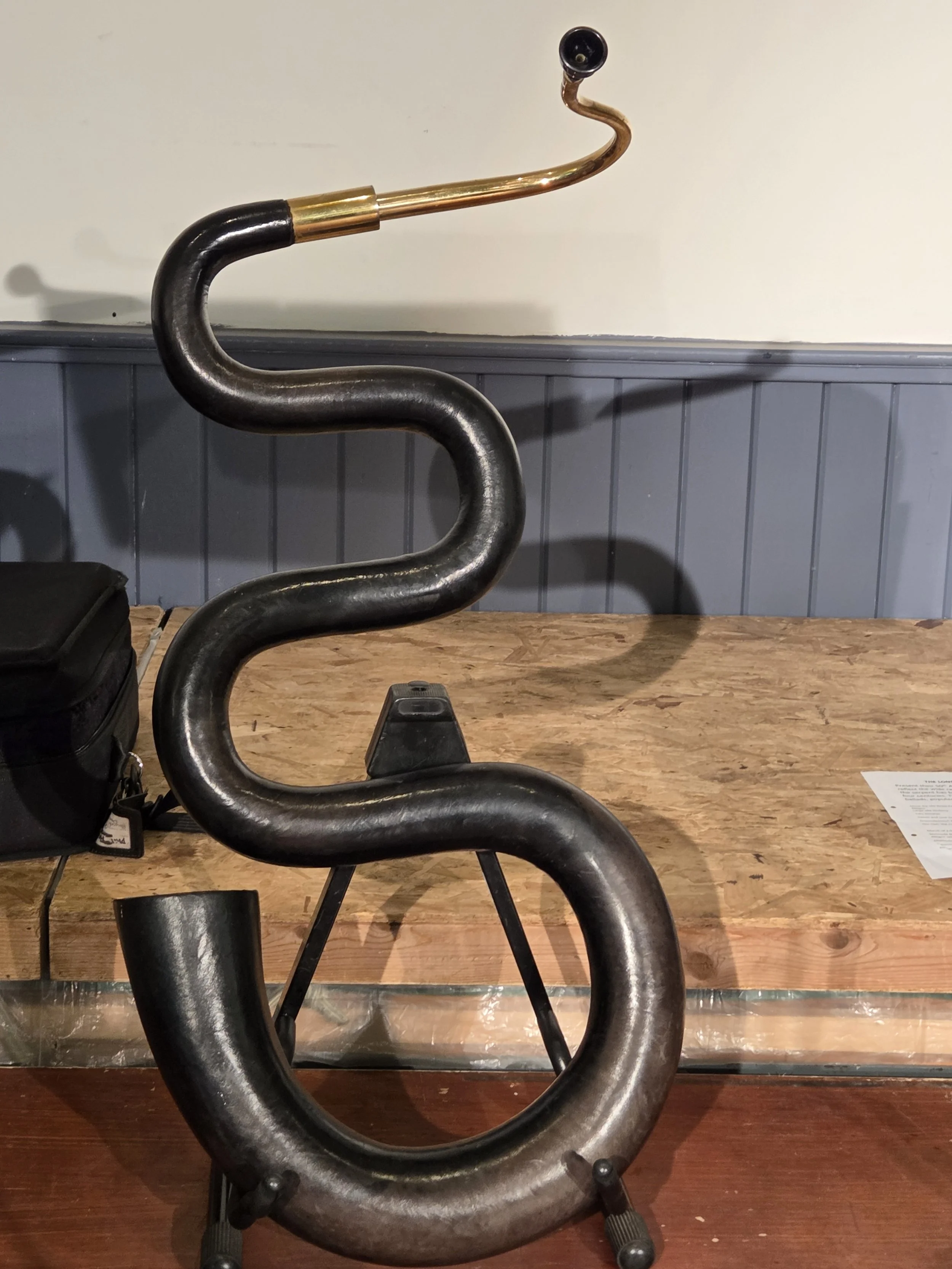
Consequently, my wife and I attended our second serpent concert, and what a delight it was! The Trio has been going since 1976, when it was founded by player and instrument maker, Christopher Monk. It has gone through a variety of players ever since, and the present line up of Philip Humphries, Andrew Kershaw and Nicholas Perry were on stage in Carlops on Friday. Christopher Monk, virtually single-handedly, reintroduced the instrument to the world, and Mr Humphries was indeed playing on one of his serpents.
The instrument was first mentioned in the late Renaissance Period, and its first appearance is reputed to be in 1590, invented by a French clergyman, Edmé Guillaume in Auxerre. It seems to have been unknown in Italy at this time, and so the assumption of a French origin is probably accurate. It was originally used to provide a cover for the Cantus Firmus in church choirs, and to bolster the bass voices at the bottom of the harmonic range. As a bass myself, I identify with this excellent invention.
The serpent has a brass neck (no puns please) which leads into a snake-shaped tube of wood, usually covered in leather. It is made from a group of similarly sized sections and stuck together in this serpentine form. The mouthpiece is close to that of a trombone or French horn, and it is played in the normal way for a brass instrument. Holes are cut in the serpent body to allow for chromatic passages, although Mr Kershaw showed us after the concert that much of the tuning is done with the embouchure (the mouth and the mouthpiece).
Groups of bassoons are often described as chugging along, and the sound of the serpent takes that chugging effect to delicious extremes.
The concert started, sensibly, with a sprightly medley of movements from Handel’s Music for the Royal Fireworks, as it allowed the listener to become accustomed to the unusual sound, in music we knew. The fascination was not only in the sound, but also in the quite different ways the three players held their instruments, from sideways in a running position (Mr Humphries) to sideways in a normal sitting position (Mr Perry) to vertical, in a sitting position (Mr Kershaw). Mr Kershaw is a professional tuba player as well, and his position matches his tuba playing one.
As the Trio was quick to point out, not much was written for serpent trio (actually nothing!), so instead of the usual arrangements chamber groups are fond of, the trio needed to do quite a bit of ‘disarranging’, to find a variety of pieces to perform.
One of the most interesting composite pieces was entitled Sweet and Low Suite, ending with Thomas Arne’s famous ‘Rule Britannia’!
After a short break to refresh their lips, the trio delighted us with more extraordinary tunes, including a serpent trio version of a Mozart Serenade for 2 oboes, 2 bassoons and 2 horns. They closed with two jolly tunes, a Charleston and Noel Coward’s ‘A Room with a View’.
What could have been a lugubrious evening of growling bass instruments (imagine a concert of three tubas?) turned into a delightful concert of fun music played by clearly fun people. A very decent audience had turned up in a rural setting whose own story was as fascinating as the serpent itself. Carlops was named after the two rock faces 60 feet high in the village, with a similar distance between. According to legend, witches used to amuse themselves by leaping from rock to rock, and the place became known as the Carlins’ Lowp, and eventually the modern Carlops.