Music at Paxton - Schubert's String Quintet
Music at Paxton, Paxton House 19/7/25
Consone Quartet: Agata Daraškaitė violin, Magdalena Loth-Hill violin, Elitsa Bogdanova viola, George Ross, cello, with Philip Higham, cello.
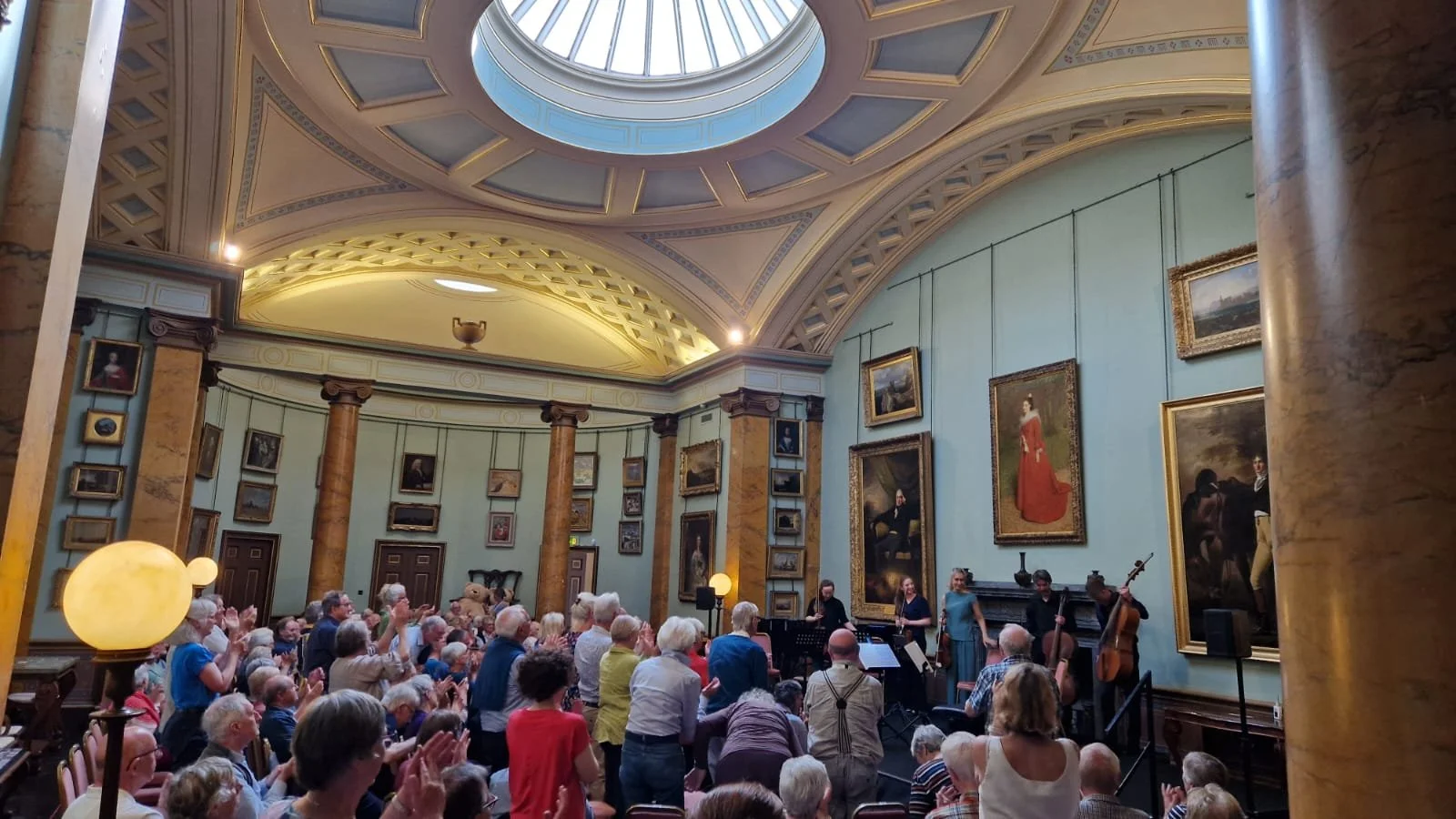
The weather is fine, despite a soggy forecast, and there’s a full house in the Picture Gallery for the Consone Quartet's farewell to Paxton. As Associate Artists for this season and the previous two, they have performed vivid and imaginative programmes ranging through the established period instrument repertoire to the avant garde in last year’s collaboration with British composer, Gavin Byers. Earlier today they played a piece by Purcell and a new composition by Oliver Leith born in 1990. Last year's concert, with mezzo Helen Charlston, of songs by the Schumanns and the Mendelssohns in arrangements for voice and string quartet is very high in my list of favourite chamber concerts. Appropriately this afternoon they have another collaboration, this time with Philip Higham, principal cellist of the Scottish Chamber Orchestra in Schubert's only string quintet.
First, they play Mozart's String Quartet in A K464 'The Drum’. This is one of six quartets which Mozart wrote after meeting Haydn and hearing some of his chamber music. He dedicated the six quartets to Haydn, writing, "I send my six sons to you. They are indeed the fruit of long and laborious study." The youthful, melodic and ever-changing music is ideally suited to the Consone Quartet. The swift-moving first movement contrasts short phrases passed around the players with unison passages, the gut-stringed instruments sounding brisk in the former and sonorous in the tutti sections. Leader Agata Daraškaitė introduces the slithering triplet motif of the second theme, a delightfully off-beat addition to the mix of sounds which makes up this movement. Later she has more intricate passages above the stave under which the other players echo her phrases. The sedate minuet features unison passages, punctuated by pauses, while in the more lyrical trio, the first violin enjoys another high-flying flight of fancy. The third movement andante is a theme with variations. It begins with a chorale-like theme in which first the two violins duet followed by the viola and cello. In the early variations, the first violin plays a complicated section over the others, but as the variations proceed the other players all have significant solos, with the cello’s main contribution being in the sixth and final variation in which his ‘rata-tat-tat’ beat underpins the other players. It continues like a distant echo through the last quiet bars of the work.The sun is still shining on the courtyard for the now traditional interval drinks, an efficient process which also contributes funds to Music at Paxton. This year the drinks on offer include non-alcoholic beer, which meets with my partner’s approval.
Cellist Philip Higham joins the quartet for Schubert’s String Quintet in C major, D 956. Written in 1828, the last year of Schubert’s life, it’s his only string quintet and unusually requires a second cello rather than a second viola. This substantial work runs to over 45 minutes, but as Schubert was not regarded then as a serious chamber music composer, its first performance didn’t take place until 1850. The added cello changes the sound of the ensemble, and the expansive resonance is obviously relished by Schubert in the quiet opening of the first movement which grows into the work’s first theme, requiring energetic rhythmical playing from all. Initially the two violins and the two cellos work in pairs, but later each instrument has its own part, the first violin often taking the higher more decorated notes, while one of the cellists play pizzicato. The last recapitulation of the theme before the more frenzied coda is a lovely example of the calm beauty of the work, and, for once, the viola part, often squeezed between the others, is clearly heard. The second movement adagio begins serenely with the first violin playing the theme, while the second violin, and sometimes a cellist and viola add an underlying drone note. The other cellist plays a slow pizzicato accompaniment. The excellent programme notes by Dr Jake Spence describe the effect as ‘other-worldly.’ There is too the sense of exploration by Schubert of the sound possibilities especially when the first violin adds its pizzicato, and the melody passes to the second violin and the viola. This serenity is swept away by the stormy central section in which a steady impassioned theme emerges. Frequently threatened by the player’s individual outbursts, it eventually changes to tentative grumbling before the first section returns, with a sense of reassurance in the extended final section.
The scherzo with horn-like fanfares has a hunting feel. It’s fast and cheerfully percussive, and the period strings make the most of the crunchy dissonant chords. This vigour contrasts with the solemnity of the slow trio. Led by the cellos it explores the lower notes of all the instruments, in a profound reflection before the hunt continues. With the flavour of Hungarian Gypsy music, especially in the upper strings, the final movement begins as an allegretto but gets faster as it proceeds. There are hints of dances, Viennese waltzes and Ländler in the rhythms until a gentler melody takes hold. Later the violins play with more flourishes during the Hungarian sections and the cellists duet on the lyrical theme, until the tempo changes to piu presto, the players throw caution to the winds and race for the finish - and a final questioning chord.
There is tumultuous applause, and, unusually for Paxton, a standing ovation - well-deserved for this committed performance, alive to all the nuances of Schubert’s light and shade. Our encore is more Schubert, a specially written arrangement for quintet by cellist George Ross’s father of the Lied Frühlingsglaube. It is moving and simple, a perfect end to today’s programme and the Quartet’s residency. They and Music at Paxton have made clear their wish for return visits in the future.