Gabrieli Roar: Dido and Aeneas
St George’s Cathedral Southwark, 14/10/2025
Guildhall School of Music and Drama: ResearchWorks, October 13, 2025
As a member of staff and a PhD candidate at the Guildhall School of Music and Drama, I attend term-time research seminars, either in person, or online from my home in Galashiels. Last week’s topic was Artistic Citizenship and Social Arts Practices in the Conservatoire presented by Dr Jo Gibson, Dr Sophie Hope and the school’s Principal, Professor Jonathan Vaughan.
The event highlighted Vaughan’s PhD research to identify socially engaged, ethical and healthy educational pathways for conservatoire students. Together with Gibson (a community music practitioner-researcher) and Hope (practice-based researcher and Lecturer in Socially Engaged Practices), the assembled students and staff gained an overview of Vaughan’s research, and the podcast work on the archive of practice undertaken by artists taught and supported by the Guildhall.
Vaughan’s project is at the stage of analysing data gathered by interview and fieldwork from 24 institutions worldwide with a particular focus on effective strategies and obstacles observed at Oberlin Conservatory in Ohio, USA. At Guildhall, and other UK conservatoires work is ongoing to provide flexibility and support for students and staff alongside critical de-colonisation of curricula. The ResearchWorks seminars are open to all.
Guildhall School's ResearchWorks series | Guildhall School of Music & Drama
So, my consciousness was firmly in the Artistic Citizenship sphere for the Gabrieli Roar presentation of Henry Purcell’s iconic opera ‘Dido and Aeneas’.
Gabrieli Roar is, in the words of artistic director Paul McCreesh, ‘an education programme which is entirely embedded in our core work and repertoire, that we train young people to share the stage with us’. Plainly speaking, this is not a side-hustle for funding and box-ticking. McCreesh and the Gabrieli Consort and Players are filling a widening gap in the education curriculum whilst flexing their musical and citizenly muscles.
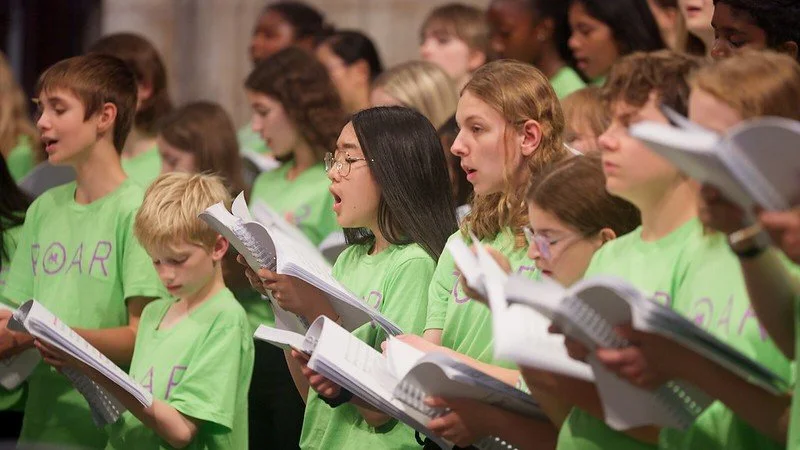
The audience in St George’s Cathedral Southwark experienced a tremendous evening of musical drama. Gabrieli, via The Southwark Schools Learning Partnership, brought together the gifts of almost 200 young people from ten schools in that borough of London, and highly trained, professional, historical performance musicians. Purcell’s ‘Dido and Aeneas’ was presented with songs and sea shanties interpolated between the opera’s five scenes, and the choir of older choristers sang most of the chorus numbers with the professional singers.
Paul McCreesh introduced each section throughout the evening, giving us information about the characters, the flavour of the music and action, the singers, and the players along with their instruments, even going into friendly detail on the bow-holds of baroque violinists. Useful and accessible, especially without the aid of surtitles nor programme synopsis.
The ‘prologue’ ‘Drink to me only with thine eyes’ was sung by the younger choristers with the string ensemble conducted by Emily Dickens (Gabrieli Roar Creative Director). The choir, some distance away from the instruments, was led on both sides by Freya Parry (Roar manager) and Marcus Farnsworth (baritone soloist, Aeneas). This was a sweet, touching performance, delighting the assembled proud parents. The inter-scene songs were arranged for strings and choir by Harry Baker, with Benjamin Britten’s accompaniment to ‘The Salley Gardens’ in evidence after the first appearance of the Witches.
The Gabrieli Players, led by violinist Catherine Martin, launched into the opera’s overture with absolute assurance and the entire ensemble moved, watched, listened and self-directed while McCreesh sat with the singers on the front row of the choir. All the instrumental sections were performed thus, and the singers sang the choruses as well as their solo roles, all memorised, all at pitch A392, a tone lower than current concert pitch.
Our Dido, Helen Charlston, was magnificent. ‘Ah, Belinda’ was the best I have heard it sung, with even tone, skilful use of text and a flexible, improvisational use of rubato over the accompanying ground bass resonances of Paula Chateauneuf and Kristiina Watt’s theorbos.
Lucy Cox and Zoe Brookshaw doubled roles as Belinda/First Witch and Second Woman/Second Witch with characterful sparkling and scheming in Purcell’s duet numbers for these characters. Brookshaw delivered with passion and clarity the stand-out ground bass song ‘Off she visits this lone mountain’, which was followed by a gentle ‘guitar dance’ on two baroque guitars.
Marcus Farnsworth is awarded the multi-tasking laurels of the evening for his youth choir conducting, (a short-notice deputy for indisposed Charles Bequignon-MacDougall) percussion-playing in the sea shanties and his beautiful singing as Aeneas – Bravo Marcus!
Emily Dickens moved from the Roar conducting podium to singing the key text of the Sorceress’ Mercury-Spirit, the moment in the story which sparks a powerful on-stage lovers’ tiff and drives Aeneas to abandon Dido.
Malachy Frame’s shining baritone voice was impeccable in ‘Come away fellow sailors’ and Martha McLorinan was impressively dastardly as the rabble-rousing Sorceress.
Throughout the opera’s performance, the young Roar singers were focussed and watchful towards the director, as were their teachers who sang within their ranks. McCreesh conducted only the choruses which involved the large ensemble of youth choirs, shimmying between the podium and the front row, where he sang with his colleagues. The rest was tightly self-directed by instrumentalists and ensemble singers, clearly and fabulously at the top of their game. Such was the devastating beauty of Charlston’s final Lament that all but the strings players missed the opening bars of the final chorus ‘With drooping wings’.
The evening closed to thunderous applause. It was uplifting, entertaining, and soul-nourishing. Edinburgh-resident harpsichordist Jan Waterfield, core keyboardist with Gabrieli, offered this reflection:
“Roar is remarkable not only because we get to play some of the best music with our amazing colleagues but also because we have the chance to extend those musical tentacles into the minds and hearts of youngsters…I can see and feel their engagement with this extraordinary art form. And we have the honour of being the first people to show them the depth and joy of this music”
Gabrieli Chief Executive, Susie York Skinner, writes:
“Gabrieli Roar works across the country with schools, choirs and participants of all abilities. Whether you’re looking to start a school choir for the first time or want a new challenge for excellent singers, whether you’re a specialist music teacher or a generalist trying to run the singing in your school, there is something here for you and we want to hear from you!”
The programme encompasses:
Roar Explore
A new series of first-access workshops for organisations without current singing provision, or to aid with recruitment to existing choirs. The legacy of Continuous Professional Development delivered and the boost to the local partner’s profile is as important as the participant experience.
Roar Evolve
Short projects or weekend courses (non-residential) designed to be accessible to a wide range of experience levels, from Year 5 upwards. Repertoire includes shorter baroque repertoire, as seen in this project (next year’s project focuses on the Vivaldi Gloria!)
Roar Empower
An annual residential course focusing on major oratorios.
Roar New Leaders
Opportunities for a small cohort of new graduates or young professionals, often Roar Alumni, to develop workshop leadership skills and support project delivery.
Joining Gabrieli Roar
• Open to all youth and school choirs with a passion for choral music.
• Gabrieli builds long-term, bespoke partnerships with choirs.
• Interested choirs or individuals can contact Anna Winstone or Freya Parry.