Usher Hall, 12/11/26
Scottish Chamber Orchestra, Andrew Manze, conductor, Sheku Kanneh-Mason, cello
SCO Academy
A very full Usher Hall awaits cellist Sheku Kanneh-Mason's first appearance with the Scottish Chamber Orchestra. And as conductor Andrew Manze says in his genial introduction, there are many treats in store tonight in a concert of youthful energy and invention.
The stage is packed too with the 36 string players from the SCO Academy sitting among the orchestra. Aged between 11 and 18 with a range of musical abilities they have worked intensively with SCO musicians, and tonight is the World Premiere of Associate Composer Jay Capperauld's 'Sinfonietta: Pathways' on which he and the Academy collaborated in workshops. The four-movement 15 minute work explores ways through life's journeys. As ever Capperauld has composed an immediately appealing work, which is by no means simple, but is for all the performers obviously a joy to play. What a great appointment this continues to be! 'Labyrinth', a lyrical look at our mythical past begins high in the violins, an effect which evokes birds twittering. Horns join in the folk-song theme. Stefan Beckett is on a full set of modern timpani, which come into play as 'Switchback's train-like chugging accelerates with great speed. The players tap their bows on wood, and at the end stamp in unison – great precision all round. 'Pilgrimage' features a lyrical melody in the winds to which the trumpets add some dissonance. 'Convergence' brings all these strands together, with lots of fast syncopation, and smiles on many faces. A triumph for all concerned, with many well-deserved shared bows.
A chamber-sized orchestra returns (and it's nice to see the young musicians watching from the choir stalls). They are as rapt as everyone else during Sheku Kanneh-Mason's performance of Haydn's Cello Concerto No 1 in C. The work is as youthful as the rest of the programme: written in the early 1760s when the long-lived Haydn was only in is his 30s, the lost and re-discovered work had its premiere in 1962. It's now at least as well-known and loved as the later concerto in D, but Kanneh-Mason and his 1700 Matteo Goffriller cello give fresh vigour to the score - a performance as mesmerising to watch as it is to hear. A cellist may be the most exciting soloist to watch: his relationship with his instrument, the notes in his head, the conductor and the orchestra are all on view.
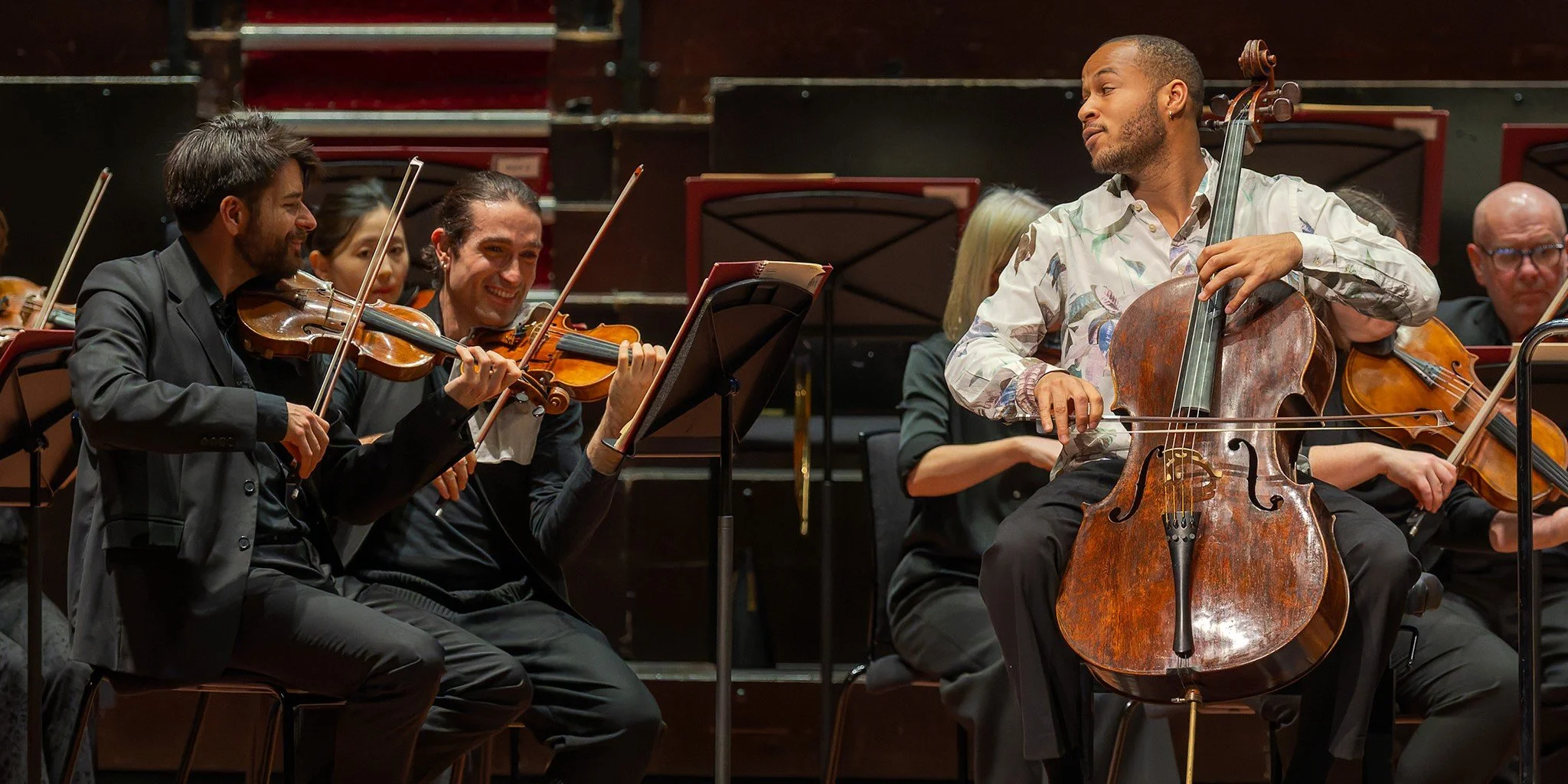
The concerto's relaxed swaying melody is repeated several times (a lasting earworm!) Yet this soloist while revelling in the sounds of the melody also experiments – a rubato here, an ornamentation there, sometimes entering a playful duel with leader Bogdan Božović. The cadenza is an exploration of the instrument as much as a response to Haydn's music, virtuosic, but also thoughtful. The adagio slow movement is for strings only. The cellist comes in on a hidden sustained note played during the orchestral introduction and in a not-quite fugal entry, the cello picks up the orchestra's theme after a couple of bars – a repeated effect. After another equally well-considered cadenza, the allegro molto which Manze takes at a fair lick gives scope for dazzling playing from Kanneh-Mason, and the orchestra. With long complicated musical lines, the soloist doesn't have a moment to rest as his hands race up and down. Breathtaking stuff - followed by tumultuous applause.
The full orchestra returns for another youthful milestone. Beethoven's Concerto No 3 Eroica is his second longest, but its length is only one of the markers which indicated his dramatic break from earlier symphonic forms. A revolutionary also in his personal beliefs, Beethoven had recently lost faith in his hero, Napoleon, after he declared himself Emperor, and apparently scored out Napoleon's name from the dedication page. The “heroic” nickname substituted by his publisher is an apt description of the symphony, which breaks convention in its striking repeated chord opening to the 17 minute first movement. The dynamic hammer-beat alternates with the main theme whose pastoral melody prefigures the Sixth Symphony. Rather than the usual lyrical slow movement, Beethoven gives us a Marcia funebre, with the insistent beat marked in the lower strings. Woodwinds provide lightness initially with the natural horns and trumpets and (smaller) timpani held back for the devastating finish. The solemnity is dispersed by the scherzo which begins pianissimo with violin bows scarcely touching the notes and soon grows to an enjoyable romp, which is halted briefly by a nicely harmonised chorale from the four horns. In a work whose YouTube versions range from 45 minutes to 54 minutes, Andrew Manze's warm reading of the score is kept towards the brisker side. The allegro molto finale is fast but the complexities of its contrapuntal sections are given their full due, and the mood towards the end is surely triumphant rather than tumultuous. A glorious conclusion to an evening of many delights.
Photo Credit: Christopher Bowen