Melbourne Symphony Orchestra
Usher Hall, 22/8/2025
Melbourne Symphony Orchestra, Jaime Martin (conductor)
Having visited Melbourne in 2023, I was intrigued to see how that great city’s top orchestra would measure up to Europe’s finest, at the beginning of an adventurous overseas tour. It is a given these days that almost any orchestra in the world will be top class, as the available pool of players seems to have expanded enormously, even as the possibilities of playing have diminished. Gone are the days of going along to the Edinburgh Festival to hear playing on a completely different level to what we were used to for the rest of the year.
The Usher Hall was packed once again (I have been greatly cheered by the attendances this year), and there was a sense of anticipation amongst the audience. The charismatic Spanish conductor, and Chief Conductor of the MSO, Jaime Martin, was a warm and exciting presence throughout the evening, and he brought a measure of Mediterranean elan to Elgar’s ‘In the South’, Opus 50, a concert overture inspired by a family holiday in Italy. This is a less well known piece by Elgar, a tone poem from 1904, reflecting the English composer’s reactions to life in the Mediterranean, and although not normally an Elgar fan, I found this piece sparkling and entertaining, and the MSO certainly played it con brio!
The second work was the World premiere of ‘Treaty’, a composition by Deborah Cheetham Fraillon for yidaki and orchestra. The yidaki is an indigenous Australian instrument, known to us by its westernised name, didgeridoo, and it was played by the world expert, William Barton. He has appeared before at the EIF in the Queen’s Hall, playing the yidaki, so I was less surprised by the sound. Using four different instruments, Mr Barton demonstrated the virtues of this extraordinary wooden tube, in a piece specially written for him by Ms Fraillon, a soprano, composer and founder of Short Black Opera, commissioned by the MSO. It explores the journey from self determination to Australia’s treaty process with First Nations People and locates the otherworldly sounds of the yidaki within the lush surroundings of warm romantic orchestral music. Not itself a particularly loud instrument, and taking much of its soundscape from the percussive ticks and growling of the player, Mr Barton had to be amplified and this caused a certain amount of consternation, as his sound came from two banks of speakers to left and right of the orchestra, and not from his position beside the conductor.
I must say I found his encore, his own composition, Kalkadungu Yurdu, much more successful from an audience point of view, but that’s not to detract from an extraordinary experience.
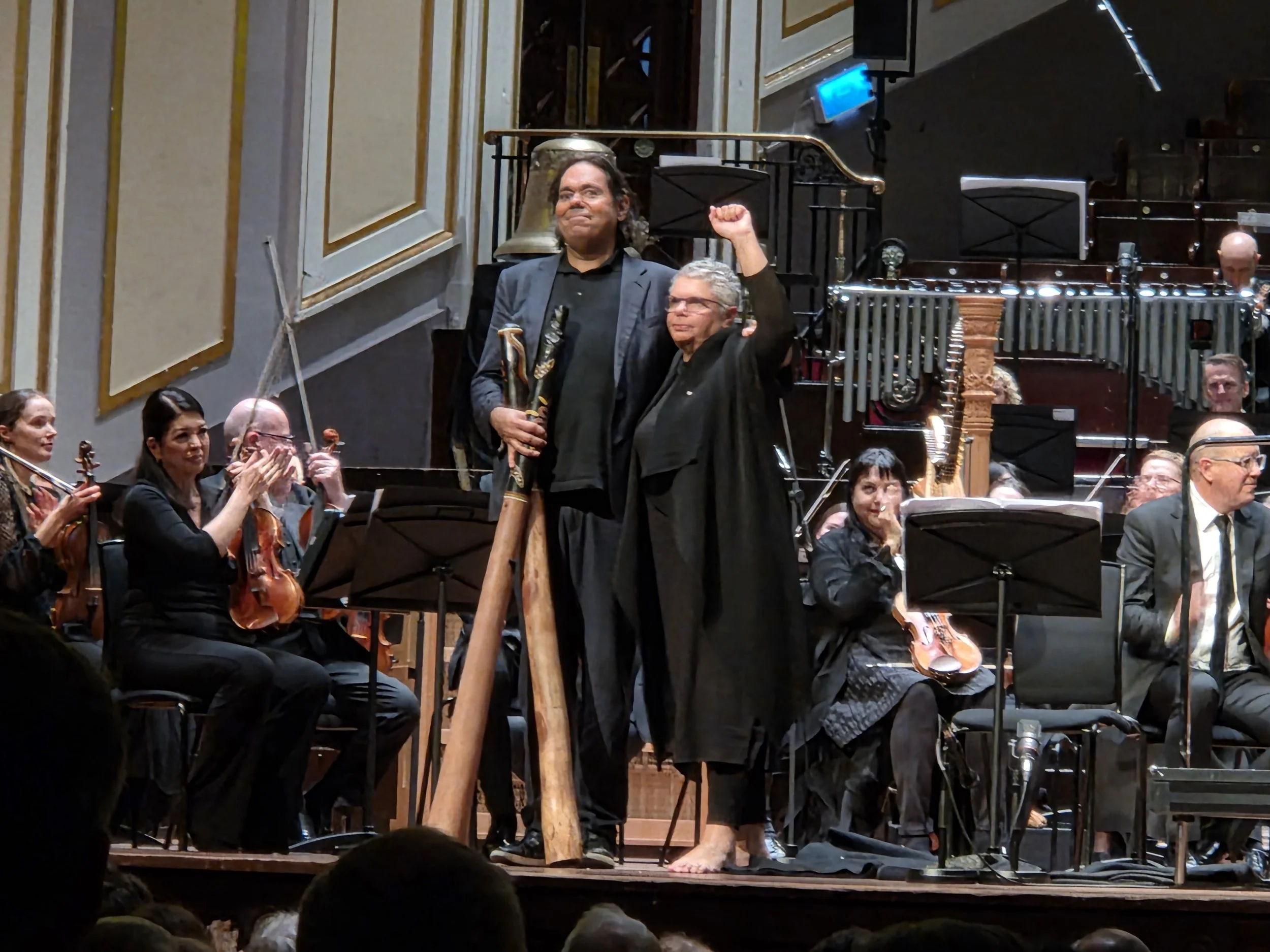
William Barton and Deborah Cheetham Fraillon
After the interval, the MSO and Jaime Martin gave us a magnificent rendition of Mussorgsky’s brilliant ‘Pictures at an Exhibition’, showing off the glories of this fine orchestra and their splendid conductor. The troubled composer wrote this series of musical snapshots of paintings by his friend Viktor Hartmann, who had died suddenly after an exhibition of his works at the Imperial Academy of Arts in St Petersburg. Written for piano, Mussorgsky never lived to hear the brilliant orchestration made in 1922 by Maurice Ravel, commissioned by Serge Koussevitzky, which has become the standard version. Mr Martin and his orchestra played the piece to the hilt, and the final ‘Great Gates of Kiev’ was overwhelming. Hartmann’s painting was a design for monumental city gates that were never constructed, but the triumphant music has taken over everyone’s imagination, and crowns the whole orchestral edifice, inspired by Mussorgsky, with brass, woodwind, percussion and a huge brass bell. Whether it had come all the way from Melbourne was a suitable teaser for the satisfied audience, who were rewarded with two encores, the overture to Glinka’s opera, ‘Ruslan and Ludmila’ and Percy Grainger’s ‘Irish Tune from County Derry’, Grainger being a native of Melbourne.