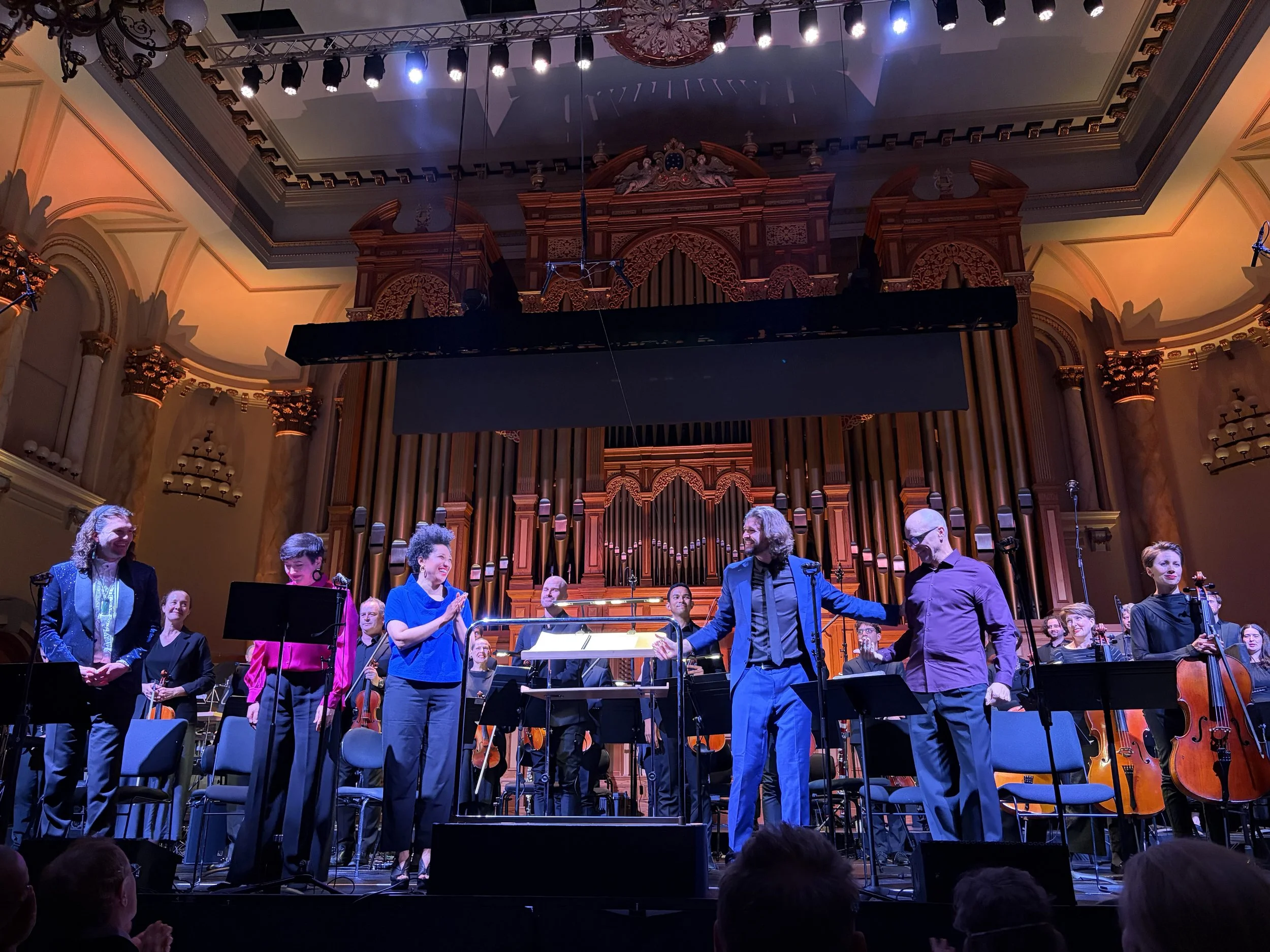
El Niño: Nativity Reconsidered
Adelaide Town Hall, 12/3/2026
El Niño: Nativity Reconsidered, Composed by John Adams, Arranged by Christian Reif, by arrangement with Origin Theatrical on behalf of Boosey & Hawkes Music Publishers Ltd., Libretto compilation Peter Sellars
Julia Bullock, soprano, Margaret Plummer, mezzo-soprano, Austin Haynes, countertenor, Simon Meadows, baritone
Adelaide Symphony Orchestra, Conductor, Christian Reif
Choir: Adelaide Chamber Singers, Artistic Director, Christie Anderson
Some performances are shaped not only by what happens on stage, but by the condition of the city receiving them. El Niño: Nativity Reconsidered arrived in Adelaide in such a moment.
Nearly a quarter-century after El Niño first came here as part of Peter Sellars’s bruised and unfinished 2002 Festival vision, John Adams’s Nativity oratorio returned in a form that felt smaller, closer and, in some ways, stronger. This chamber version, shaped by Julia Bullock and arranged by Christian Reif, does not diminish the work. It concentrates it. Sitting only six rows back, I felt that intensely. The music and words did not have to cross some grand ceremonial distance. They arrived directly. The intimacy was not incidental. It was the work’s method.
That closeness suits the piece. This is not Nativity as pageant or seasonal comfort. Adams and Sellars reopen the sacred story through women’s voices and Latin American poetry, holding birth alongside fear, tenderness alongside violence, and hope alongside exile. Miracle is never separated from danger. New life enters not a protected world but a wounded one. Bullock’s reshaping of the piece, with its clear centring of the maternal voice, makes that feel even more immediate.
It also meant the performance landed with unusual force in Adelaide in 2026. This has been a wounded festival season. The silencing of Randa Abdel-Fattah from Writers’ Week, and the events that followed, left a mark well beyond literature. Out of that damage came Constellations, the alternative festival that briefly and painfully took shape in the space left behind. I do not want to overburden a music performance with external controversy. But it would be false to pretend the context was absent. A work about threatened birth, vulnerable life and voices under pressure could not help but sound differently in a city where one cultural gathering had been broken and another had to be born from below.
What this version gains by reducing scale is concentration. Nothing felt watered down. On the contrary, the emotional pressure intensified. What might in a larger setting register as grandeur here became encounter. Rather than proclamation, this felt like witness. Rather than inherited religious certainty, it offered something more searching and exposed. That is where Adams and Sellars remain such a potent pairing: the sacred and the political are not placed in separate boxes, and neither are beauty and unease.
Bullock was plainly the centre of gravity, and her spoken start mattered. From those opening moments, she set the intimate and exposed terms of the whole evening, as if inviting the audience not simply to listen but to enter the work’s vulnerable space. Around her, Margaret Plummer brought operatic steadiness and depth, Austin Haynes added the high, hovering countertenor colour the piece needs, and Simon Meadows supplied grounded baritone weight. Together they did not feel like a sequence of separate turns so much as a shared act of witness. Reif’s shaping hand as arranger-conductor, and the strength of the Adelaide Symphony Orchestra and Adelaide Chamber Singers, gave the performance body and seriousness without sacrificing intimacy. It felt less like a prestige import than a real Adelaide event.
Even the work’s history in this city deepened that feeling. El Niño first arrived here in 2002 as part of Sellars’s attempt to imagine a festival that might do more than decorate public life. That larger vision was never fully realised. This return did not recreate that moment, but it did carry its memory. You could feel, behind the music, the persistence of an older argument: that beauty and conscience, the sacred and the political, belong in the same room.
Still, the ending did not quite satisfy. It came with a suddenness that disappointed, leaving a feeling of incompleteness, of unfinished business. Perhaps that refusal of full closure belongs to the work’s deeper logic. But in the room it felt abrupt. The applause, though, was sustained just long enough to confirm that something real had passed between performers and audience. Not rapture. Not triumph. But connection.
That seems, finally, the right word for the night. El Niño: Nativity Reconsidered did not overwhelm by scale or dazzle by sheer display. It worked more quietly and more deeply than that. Six rows back, it felt intimate, serious and exposed. And in a city where one festival had been wounded and another briefly reborn in its place, this Nativity story of vulnerable arrival, threatened life and fragile hope felt more piercing than it otherwise might have. Not closure. Not consolation. But a form of witness. Onwards.